6 November 2026
Finding out what engine is in your car is not quite as simple as reading the badge on the boot. A model described as a 1.6 petrol or 2.0 diesel can still have several different engine codes depending on the year, emissions standard, power output, gearbox, drivetrain and production revision. The safest approach is to combine the registration number, V5C, VIN, manufacturer records and the physical engine marking before ordering parts or comparing replacement engine options.
If you are trying to source an engine, the detail that usually matters most is the engine code. This helps identify the engine family or variant, rather than just the size. It is different from the engine number, which normally identifies the individual engine unit fitted to the vehicle.
For UK motorists, Motor Fix Way can help when you are ready to compare replacement engine quotations, but the more accurate information you provide, the better suppliers can check compatibility. A registration number is a useful starting point, but it should not be treated as proof that any engine with the same capacity will fit.
The quickest way to begin is with the vehicle registration number, but it should only be the first step. Registration data can help confirm the vehicle's recorded engine size, fuel type and other basic details, while documents and physical markings can help narrow down the exact engine code.
GOV.UK provides a vehicle information service that allows you to check recorded details using the registration number. This can include information such as make, year of manufacture, fuel type, engine size, emissions and MOT-related information. You can use the official DVLA vehicle information service as a reliable starting point.
However, this is not the same as a guaranteed manufacturer engine code lookup. The DVLA record may show engine capacity in cubic centimetres and the fuel type, but it may not display the precise engine variant needed for a replacement engine order. It may also reflect the vehicle details recorded with DVLA, which is not always enough to prove what is physically fitted now, especially if the engine has been changed before.
Your V5C log book can be useful because it records key vehicle details, including cylinder capacity, fuel type and, where listed, the engine number. This information helps confirm what is recorded for the vehicle, but it may not provide the full engine code in the same format a parts supplier or engine specialist needs.
Compare the V5C with the service history, any previous engine replacement invoices and the physical engine marking. If the car has had a replacement engine, the paperwork is especially important because the current engine may not match the original factory unit in every detail.
The Vehicle Identification Number, usually shortened to VIN, is the unique identity number for the vehicle. It is commonly found at the base of the windscreen, on a door pillar or door jamb, on the V5C, and sometimes in the engine bay or manufacturer owner's portal.
A VIN can help a manufacturer, dealer parts department or suitable supplier retrieve the original factory specification. What it should not be used for is guesswork. You may see online claims that a certain VIN character always identifies the engine, but VIN structures vary by manufacturer and market. If exact compatibility matters, use manufacturer documentation or a professional parts system rather than a generic rule.
Some manufacturers record engine and gearbox information on a vehicle data sticker, service book label or production information sticker. Depending on the make and model, this may be in the service booklet, boot area, luggage compartment, engine bay, timing belt cover area or on a vehicle identification plate.
These labels can be extremely helpful because they may list engine and transmission codes together. The catch is that not every vehicle has the same layout, and older cars may have missing books, replacement panels or unreadable stickers. Treat the data sticker as strong evidence, but still cross-check it if the vehicle has an uncertain history.
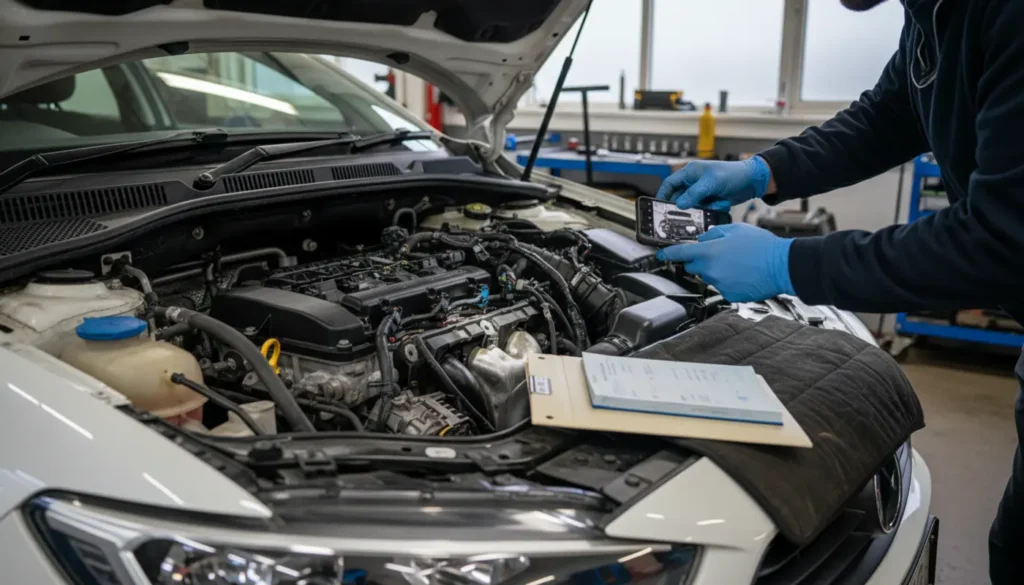
The engine code or engine number may be stamped into the engine block, crankcase or another metal surface, or shown on a label near the engine. On some vehicles it is easy to see; on others it is hidden under covers, pipes, grime or awkward access points. In other words, it may be less of a quick peek and more of a torch, patience and mild muttering job.
Do not remove components or work around hot, moving or electrically live parts just to find a marking. If the code is difficult to access, ask a qualified garage to check it. A clear photograph of the marking can also help when discussing the vehicle with a supplier.
These terms are often mixed up, but they do different jobs. Knowing the difference can save you from ordering the wrong part or giving a supplier information that sounds useful but does not identify the engine.
If your car has an engine management light on, an OBD code may help a technician investigate the problem, but it will not tell you which replacement engine to order. For more on that separate subject, see how to check engine light codes.
A registration number can help narrow down the vehicle, but it should not be treated as definitive proof of the exact engine code. It may confirm the recorded make, fuel type and engine capacity, and it can be useful when requesting quotations, but suppliers may still need the VIN, engine code, engine number or photos of the engine marking.
This matters because vehicle ranges often include several engines that appear similar on paper. A 2.0 diesel badge, for example, may cover different engine codes across different years, power outputs, emissions systems and gearbox combinations. Two engines can share the same capacity and still differ in wiring, sensors, turbocharger arrangement, ECU requirements, mounting points or transmission compatibility.
Engine capacity is only one part of the picture. It tells you the approximate swept volume of the engine, not its full specification. Ordering an engine by size alone is one of the most common mistakes motorists make, particularly when buying a used or reconditioned unit.
Compatibility may depend on the exact engine code, fuel type, power output, emissions equipment, starter and alternator arrangement, injectors, turbocharger, wiring loom, ECU, gearbox type, drivetrain and production date. Even small differences can create fitting problems, warning lights or parts that cannot be transferred easily.
When comparing replacement options, ask suppliers to confirm the match using all available information rather than relying on the advert description or badge. If you already know you need an engine, comparing used replacement engines can be a sensible route, provided compatibility, condition and warranty terms are checked carefully.
Before requesting a quote, gather as much information as possible. A supplier may not need every detail in every case, but complete information reduces the risk of confusion and helps avoid comparing the wrong options.
You should also ask what is included with the replacement unit. A bare engine, a complete engine and an engine with ancillaries can mean different things depending on the supplier. Clarify whether items such as the turbocharger, injectors, starter motor, alternator, manifolds, flywheel, clutch, sensors, wiring or ECU are included, excluded or expected to be transferred from your old engine.
If the code is missing, dirty or unreadable, do not guess. Start with the owner's manual, service records, invoices and vehicle data stickers. If you can see a marking but not read it clearly, take a well-lit photograph and avoid aggressive cleaning that could damage a label or stamped surface.
A qualified garage, manufacturer's dealer parts department or suitable engine supplier may be able to identify the correct unit using a combination of registration, VIN, V5C details and photographs. If you are comparing reconditioned engine options, ask the supplier what evidence they need to confirm compatibility before you commit.
If relevant vehicle details change, such as engine number, cylinder capacity or fuel type, the V5C may need to be updated. GOV.UK guidance explains that evidence may be required in some circumstances, such as a receipt for the replacement engine showing the engine number and cylinder capacity, manufacturer evidence, an inspection report or written confirmation from a garage.
Keep invoices, supplier paperwork and fitting documentation. A like-for-like replacement may not change every recorded detail, but you should check the current DVLA requirements if the engine number, capacity or fuel type differs from the existing record. Your insurer should also be informed about relevant engine changes, particularly if the specification is not the same as before.
Finding your engine code tells you what engine you have; it does not prove the engine must be replaced. Poor starting, smoke, overheating, coolant loss, knocking noises or low compression can point to serious problems, but a qualified technician should confirm the cause before you spend money on a replacement unit.
In some cases, a repair may be more suitable. In others, a used or reconditioned engine may make better financial sense, especially where internal damage is severe or repair labour would be high. Compare the confirmed fault, vehicle value, mileage, parts availability, warranty terms and expected future use before deciding.
A used engine is normally removed from another vehicle and sold based on its recorded condition, mileage and supplier checks. It may be attractive where cost and availability are priorities, but you should ask about provenance, testing, included parts, warranty conditions and return terms.
A reconditioned engine has had work carried out to restore or rebuild parts of the unit, but the scope can vary. Ask what has been inspected, machined, replaced and tested. Do not assume every reconditioned engine has the same rebuild standard, included components or warranty requirements.
Whether you choose used, reconditioned, supply-only or a supplier-arranged fitting option, the engine code is a key part of the matching process. It helps suppliers avoid offering an engine that looks right in broad terms but differs in the details that matter during installation.
Most engine ordering problems start with incomplete information. If you are unsure, slow down and verify the details before paying for a unit or arranging fitting.
How do I find out what engine is in my car?
Start with the registration number to check basic recorded details, then verify the V5C, VIN, service records, manufacturer data sticker and physical engine marking. The engine code is usually the most useful detail when sourcing a replacement.
Is the engine code on the V5C?
The V5C may show engine capacity, fuel type and an engine number where recorded, but it does not always show the full manufacturer engine code. Check service documentation, data stickers and the engine itself as well.
Is the engine number the same as the engine code?
No. The engine code usually identifies the engine type or variant, while the engine number identifies the individual engine unit fitted to the vehicle.
Can I find my engine code using my registration number?
A registration lookup can help confirm basic vehicle information and may help suppliers narrow down the specification. It should not be treated as a guaranteed full engine code lookup.
Can two engines with the same size be interchangeable?
Not necessarily. Engines with the same capacity can differ in code, electronics, emissions equipment, mounts, gearbox pairing and production revision, so compatibility should be professionally checked.