
6 November 2026
A timing belt should normally be changed at the manufacturer's stated mileage or age limit, whichever comes first. That is the key point. Some cars are due because they have covered enough miles, while others are due simply because the belt is old, even if the odometer looks reassuringly low.
In the UK, broad guidance often puts cambelt replacement somewhere between about 40,000 and 100,000 miles, with age limits commonly starting from around four years and extending further depending on the vehicle. Those figures are only a guide, not a rule. The exact schedule depends on the make, model, engine, production year and sometimes the engine code.
A valid MOT does not confirm that your timing belt is healthy or within its service interval. The MOT is a roadworthiness test, not a full mechanical service. For belt replacement, the service handbook, digital service record or manufacturer schedule matters far more.
If a timing belt has failed and internal engine damage is suspected, the decision may move beyond routine maintenance and into repair versus replacement. In that situation, Motor Fix Way can help UK motorists compare suitable replacement engine options from suppliers, subject to exact vehicle compatibility and availability.
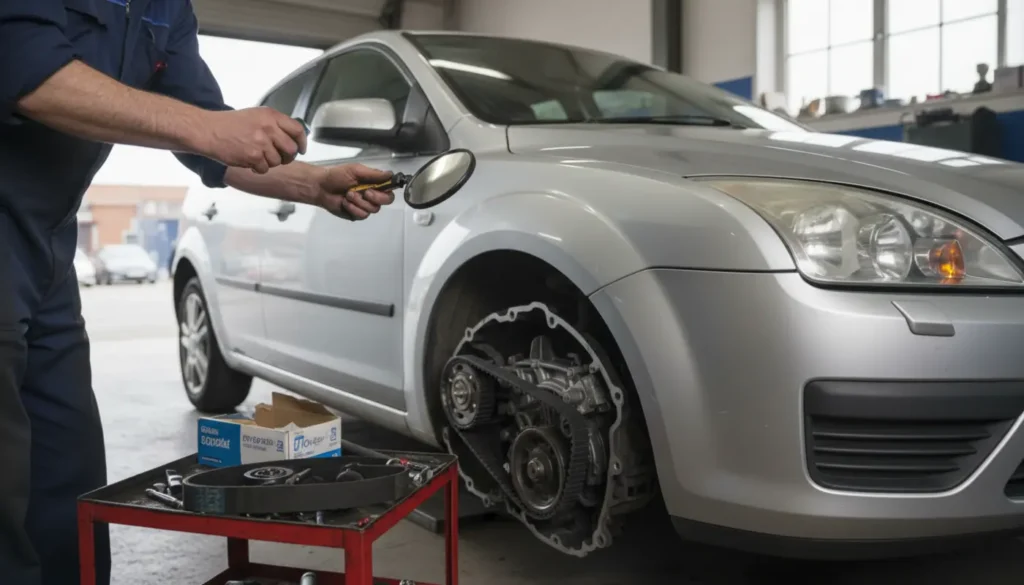
A timing belt, also called a cambelt or cam belt, is a toothed rubber belt that keeps the crankshaft and camshaft moving in the correct relationship. In simple terms, it helps the pistons and valves do their jobs at precisely the right time. If that timing is lost, the engine can run badly, refuse to start or suffer serious internal damage.
The belt is usually hidden behind covers, so it is not as easy to check as an auxiliary belt. Looking at a small visible section, where one exists, does not prove the whole belt is safe. Cracking, fraying or missing teeth would be concerning, but many belts fail without giving an obvious visual warning first.
If you want a plain English explanation of what the component actually does inside the engine, this related guide on how a timing belt keeps the engine in time is a useful companion read.
A timing belt and timing chain perform a similar job, but they are built differently. A belt is usually made from reinforced rubber and runs around toothed pulleys. A chain is metal and runs in an oil-lubricated system, more like a bicycle chain in basic principle, though considerably more precise and complex.
It is a mistake to assume that a timing chain is maintenance-free forever. Chains, guides and tensioners can wear, oil quality can affect their life, and some engines have known chain-related issues. Equally, do not assume your car has a belt or chain based only on the badge on the boot. The same model name may have different engines across different years and trim levels.
The correct answer is vehicle-specific. Your handbook or manufacturer service schedule may state something like a mileage limit, an age limit, or both. If the schedule says 60,000 miles or five years, the belt is due when either limit is reached first. A car that has covered only 35,000 miles can still be overdue if it is older than the specified age limit.
Mileage matters because the belt, tensioners and related components are constantly working while the engine is running. Age matters because rubber and reinforcing materials can deteriorate through heat cycles, contamination, oil exposure, coolant leaks and simple time. A lightly used car is not automatically protected from belt ageing.
Manufacturer schedules can also change by engine variant. For example, one engine in a model range may use a conventional dry belt, another may use a timing chain, and another may use a wet belt running in oil. That is why accurate identification is essential before you book the work or buy parts.
A registration number is helpful, but it does not always tell the full story. For accurate timing-belt guidance, a garage or parts supplier may need the VIN, engine code, fuel type, model year and production date. This is especially important where a model was sold with several engines or where there were mid-production changes.
If you are unsure which engine is fitted, checking the code is a sensible first step. Motorists can use this guide to identify your engine code before ordering parts or comparing engine options, which is particularly useful when service history is incomplete or the vehicle has had previous major work.
Service records are just as important. A stamped book entry is helpful, but an invoice showing the date, mileage, vehicle details and parts used is better. If a seller says the cambelt has been changed but cannot provide evidence, treat that claim cautiously. It may still be true, but without proof you should budget and plan as though it may be due.
Before approving a cambelt job, it is worth asking exactly what is included. A cheap-sounding price for the belt alone may not be comparable with a quotation that includes a full kit, coolant and water pump where required.
Water-pump replacement is common on many timing-belt jobs because access overlaps and the pump may be driven by the belt. However, it is not safe to say every car always needs a water pump with every belt. The correct answer depends on the engine design, condition and technician's assessment.
Timing belts can fail without warning, which is why scheduled replacement is so important. Still, there are symptoms that should prompt caution. Unusual rubbing, slapping, ticking or scraping noises from the belt area should not be ignored. Rough running, misfires, poor performance or difficulty starting can also be associated with timing issues, although they can have many other causes too.
If the engine management light appears alongside poor running, do not assume the timing belt is definitely at fault. Sensors, ignition faults, fuel problems, air leaks and emissions-related issues can create similar symptoms. A diagnostic scan and mechanical checks are often needed. This engine management light guide explains why the warning light should be investigated rather than guessed at.
If the engine stops suddenly, cranks unusually quickly, makes severe mechanical noise or you suspect the belt has jumped or snapped, avoid continuing to drive. Further running may increase the damage, depending on the engine and the fault. Arrange recovery or professional diagnosis instead.
When a timing belt breaks, the crankshaft and camshaft are no longer synchronised. On many interference engines, this can allow pistons and valves to collide. Possible damage includes bent valves, damaged pistons, broken rocker arms, cylinder-head damage and, in severe cases, a major engine repair bill.
That said, a snapped timing belt does not automatically mean the engine must be replaced. A proper assessment may include checking the timing, carrying out compression tests, inspecting cylinders with a borescope and removing the cylinder head if necessary. Only then can a garage compare the cost of repair with the cost of a suitable used or reconditioned replacement engine.
If a replacement engine is being considered, compatibility must be checked carefully. The engine code, emissions equipment, gearbox type, sensors, ancillaries and control systems can all matter. A similar engine size or model name is not enough on its own.
No, an MOT does not confirm timing-belt condition or replacement status. GOV.UK explains that the MOT checks whether a vehicle meets road safety and environmental standards at the time of the test, but it does not cover the general condition of the engine, clutch or gearbox. You can read the official explanation of how the MOT test works.
This is a common misunderstanding. A car can pass its MOT and still be overdue for a cambelt change. The MOT tester is not responsible for dismantling belt covers or checking whether the belt is within its manufacturer service interval. For that, you need service records and vehicle-specific maintenance information.
There is no single UK price that applies to every timing-belt job. Costs vary because some engines are straightforward to access, while others require significant dismantling. Parts choice also matters. A complete timing-belt kit with tensioners, idlers and a water pump where applicable will cost more than a belt alone, but it may be the more appropriate repair for the vehicle.
Labour rate, location, vehicle age, seized fasteners, coolant requirements and additional faults can all affect the final invoice. A preventative timing-belt replacement is usually a more controlled job than dealing with a failed belt, because failure can introduce diagnosis, engine strip-down work and internal damage.
When comparing quotations, make sure they are genuinely like for like. Ask whether the quote is parts-only or supply-and-fit, whether VAT is included, what parts brand or specification will be used, and what warranty applies to parts and labour. A low headline figure is less helpful if important components are excluded.
The biggest mistake is relying on a universal mileage rule. Not every car needs a timing belt at 60,000 miles, and not every belt safely lasts to 100,000 miles. The manufacturer schedule for the exact engine is the starting point.
Another mistake is waiting for symptoms. A belt does not need to look dramatic before it becomes due. If the schedule says it is due by age or mileage, the absence of noise is not a reason to ignore it. Equally, do not confuse the timing belt with the auxiliary belt, which drives items such as the alternator or air-conditioning compressor on many vehicles.
Used-car buyers should be particularly careful. If the cambelt history is unclear, ask for invoices, not just verbal reassurance. The cost of a belt change may affect whether a car is good value, especially on older vehicles where maintenance history matters as much as mileage.
If the replacement history is known and documented, check the date and mileage against the manufacturer schedule. If either limit is approaching, plan the work before it becomes overdue. If the history is unknown, get vehicle-specific advice from a qualified garage and consider preventative replacement if the belt cannot be verified.
If the vehicle uses a wet belt, be especially careful with oil specification and service history. Wet belts operate in engine oil, so incorrect oil, missed servicing or contamination may be relevant on some designs. Do not apply a dry-belt schedule without checking the correct manufacturer guidance.
If the belt has failed, stop treating the issue as routine maintenance. At that point, the priority is diagnosis. Once the damage is understood, you can compare repair with replacement engine options and decide which route is most sensible for the vehicle's value, condition and intended use.
How many miles does a timing belt last?
Many timing-belt intervals fall somewhere between about 40,000 and 100,000 miles, but this is only broad guidance. Always follow the manufacturer schedule for your exact engine.
Should a timing belt be changed by age or mileage?
Usually it should be changed at whichever manufacturer limit comes first. A low-mileage car can still be due if it has reached the age limit.
Does an MOT check the cambelt?
No. An MOT is not a full mechanical service and does not confirm that the timing belt is within its replacement interval.
Should the water pump be changed with the timing belt?
Often it makes sense where the water pump is belt-driven or access overlaps, but it depends on the engine and the quotation. Ask the garage exactly what is included.
What should I do if the timing belt has snapped?
Do not continue driving or repeatedly try to start the engine. Arrange professional diagnosis, then compare repair costs with suitable replacement engine options if internal damage is confirmed.