
6 November 2026
An engine light usually means your car’s electronic control unit has detected a fault in a monitored system, such as ignition, fuelling, airflow, emissions control or engine temperature. It does not automatically mean the engine has failed, and it certainly does not mean you should rush into buying parts before the fault has been properly diagnosed.
The engine management light is also called the check engine light, malfunction indicator lamp or MIL. Manufacturers use slightly different symbols and warning behaviours, so your vehicle handbook should always be the first reference. In simple terms, the car has spotted something outside its expected range and wants attention before a small fault becomes a larger one.
A steady amber engine light usually means you should arrange diagnosis promptly and drive cautiously only if the car is behaving normally and the handbook allows it. A flashing engine light is more urgent, especially if the engine is juddering, smoking, overheating, losing power or smelling strongly of fuel.
If diagnosis later confirms serious internal engine damage, Motor Fix Way can help UK motorists compare supplier quotations for used, reconditioned or replacement engine options. However, the warning light itself is only the starting point, not the final diagnosis.
The engine management light comes on when the vehicle’s control system records a fault or abnormal reading. This may involve a sensor, wiring circuit, emissions component, fuel system, ignition part or a mechanical condition affecting how the engine runs.
A common mistake is to assume that the part named in a diagnostic code has definitely failed. For example, an oxygen sensor code may point towards the sensor circuit, but the real cause could be an exhaust leak, wiring fault, air leak or fuelling problem. A diagnostic scan gives useful clues, but the code still needs to be interpreted alongside symptoms and proper testing.
If you want a broader explanation of the warning itself, this related guide on the engine management light meaning explains the basics in more detail.
A steady amber light often means the vehicle has stored a fault but may still be running reasonably well. That does not make it harmless. Continuing to drive for weeks without diagnosis can allow emissions faults, misfires or fuelling problems to damage other components.
A flashing engine light should be treated as urgent. It can be associated with an active misfire, where unburnt fuel may enter the exhaust and risk damaging the catalytic converter. If the car is shaking, struggling to accelerate, overheating, producing smoke or showing a red oil pressure or temperature warning, stop safely and seek professional assistance rather than trying to nurse it home.
A misfire happens when one or more cylinders are not burning fuel correctly. Common causes include worn spark plugs, faulty ignition coils, injector problems, air leaks, compression issues or timing faults. Symptoms can include juddering, rough idle, hesitation, loss of power and, in more serious cases, a flashing warning light.
Oxygen sensors, often called lambda sensors, monitor exhaust gases so the ECU can adjust the air and fuel mixture. A fault may increase fuel consumption, raise emissions or trigger poor running. However, a lambda sensor code does not always mean the sensor itself is bad, so wiring, exhaust leaks and mixture problems should be checked too.
The catalytic converter helps reduce harmful exhaust emissions. If the ECU detects poor catalyst efficiency, the light may appear. The cause could be a worn catalyst, but it could also be a previous misfire, oil burning, exhaust leak or faulty sensor. Replacing a catalyst before checking upstream faults can be an expensive shortcut to nowhere.
Mass airflow and manifold pressure sensors help the ECU calculate how much air is entering the engine. If the reading is wrong, the car may hesitate, idle roughly, use more fuel or feel flat under acceleration. Split intake hoses, damaged wiring and dirty sensor elements can all produce similar symptoms.
The exhaust gas recirculation valve, usually shortened to EGR, recirculates a controlled amount of exhaust gas back into the intake to help reduce certain emissions. Carbon build-up, sticking valves, wiring faults or control issues can trigger the engine light. Diesel engines are especially known for EGR-related problems, although petrol engines can use EGR systems too.
Diesel particulate filters trap soot from diesel exhaust gases and periodically regenerate to burn it off. Short journeys, failed sensors, EGR faults, injector issues or a blocked filter can lead to warning lights and reduced power mode. Removing a factory-fitted DPF is not a proper repair and can create legal and MOT problems.
Fuel system faults can cause hard starting, rough running, smoke, poor acceleration or increased fuel use. Petrol and diesel systems differ, but both rely on accurate fuel delivery. A technician may need to check fuel pressure, injector operation, wiring, fuel quality and related sensors before deciding which part is at fault.
An air leak can let unmetered air into the engine, while a boost leak on a turbocharged vehicle can reduce power and confuse sensor readings. Exhaust leaks can also affect oxygen sensor data. Split hoses, loose clamps, cracked pipes, intercooler leaks and manifold leaks are all worth checking before blaming an expensive sensor.
The ECU uses coolant temperature information to manage fuelling, emissions and cooling fan operation. A faulty sensor, thermostat problem, wiring issue, coolant leak or actual overheating event can trigger a warning. If the temperature gauge rises quickly, a red warning appears or coolant is visibly leaking, stop safely and do not continue driving as if it is only a sensor issue.
Less commonly, the light can relate to deeper issues such as low compression, timing chain or belt problems, valve damage, piston damage, oil pressure concerns or complex wiring faults. These require proper testing, such as compression checks, leak-down testing, oil pressure measurement or timing inspection. Engine replacement should only be considered when serious internal damage or an uneconomic repair has been confirmed.
Your first job is not to panic. Your second job is not to ignore it either. Take a moment to assess how the car is behaving, because symptoms often tell the technician as much as the light itself.
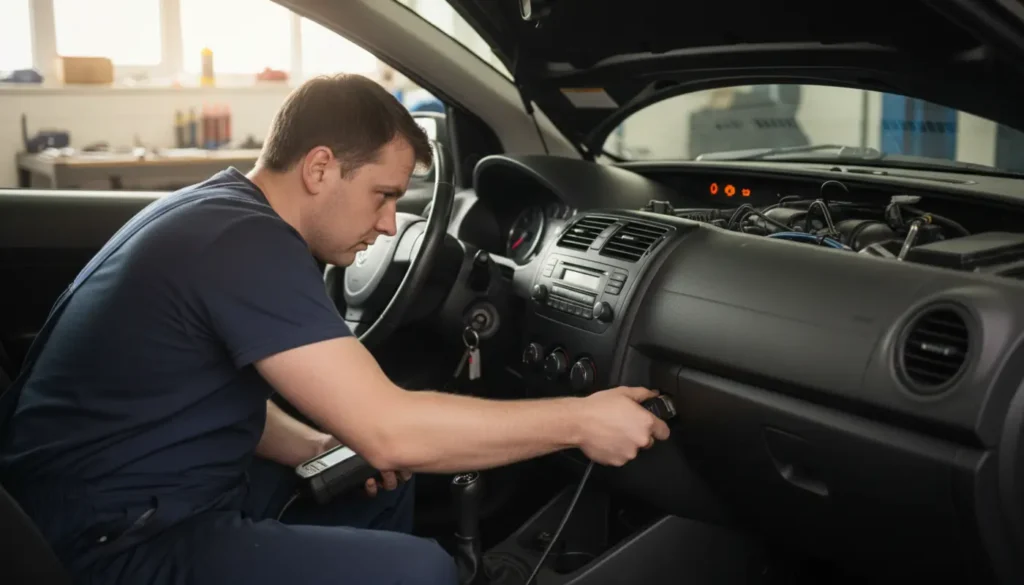
A scan tool can retrieve stored and pending diagnostic codes, but clearing the code is not the same as fixing the fault. If you would like to understand the process before visiting a garage, this step-by-step UK guide explains how to check engine light codes and what those codes can and cannot tell you.
For applicable vehicles, the MOT inspection includes checks relating to the malfunction indicator lamp. DVSA guidance says the MIL should illuminate with the ignition and then go out, although some vehicles require the engine to be started before it goes out. A MIL that is inoperative or indicates a malfunction is listed as a major defect in the relevant inspection sections.
The exact MOT assessment can depend on the vehicle, age, fuel type, emissions equipment and specific test requirements. The official DVSA MOT inspection manual for emissions and nuisance checks is the authoritative source for current UK test guidance.
It is not sensible to clear the light just before an MOT and hope for the best. If the underlying fault remains, the light may return, readiness monitors may not complete, or the vehicle may still fail on emissions or missing emissions control equipment.
Most engine lights do not lead to an engine replacement. Many are caused by external components such as coils, sensors, injectors, leaks, wiring or emissions equipment. Replacement only becomes relevant if testing confirms major mechanical damage, such as severe compression loss, timing failure, overheating damage or another issue that makes repair uneconomic.
If a replacement engine is being considered, compatibility must be confirmed carefully. An engine with the same size or from the same model range is not automatically interchangeable. Suppliers may need the registration, VIN, production year, fuel type, power output, emissions specification, transmission type and exact engine code. If you are unsure where to find that information, this guide explains how to identify the engine in your car.
If the engine itself is mechanically sound, repairing the root cause is usually the correct route. That might mean replacing a failed coil, fixing a boost leak, cleaning or replacing an EGR valve, repairing wiring, resolving injector issues or correcting an exhaust fault.
Where serious internal damage is confirmed, motorists may compare used and reconditioned engines. A used engine may be suitable where condition, mileage evidence, compatibility and warranty terms are acceptable. A reconditioned engine may have had selected components inspected, machined or replaced, but the meaning of reconditioned can vary, so the supplier should explain exactly what work has been carried out.
Always compare like for like. A part-only quote may not include removal, fitting, fluids, filters, belts, chains, seals, programming, recovery, delivery or post-installation testing. Warranty terms also vary, including whether labour is covered and what fitting requirements apply.
Before spending money on repairs or replacement parts, ask clear questions and get the answers in writing where possible. This helps avoid confusion and gives you a better basis for comparing options.
A good diagnosis may feel slower than simply replacing the first part mentioned by the fault code, but it is usually the safer and more cost-effective route. Cars can be dramatic, but they are not always telling the full story with one warning light.
Can I drive with the engine management light on?
If the light is steady and the car drives normally, check the handbook and arrange diagnosis promptly. If the light is flashing, the engine is misfiring, overheating, smoking or losing power, stop safely and seek urgent help.
Can a loose fuel cap cause the engine light?
On some vehicles, a loose or faulty fuel cap can trigger an evaporative emissions fault. It should still be confirmed with a diagnostic scan, because similar warnings can have different causes.
Does a diagnostic code identify the exact faulty part?
Not always. A code identifies a fault condition or circuit, but further testing is often needed to prove whether the sensor, wiring, air leak, fuelling issue or mechanical fault is responsible.
Can a DPF problem turn on the engine management light?
Yes, depending on the vehicle. A blocked or poorly regenerating DPF can trigger warning lights and reduced power, but the root cause may be another fault such as an EGR, injector, sensor or driving pattern issue.
Does the engine light mean I need a replacement engine?
No. Many engine light causes are sensor, ignition, fuel, air, exhaust or emissions-related. A replacement engine should only be considered after proper diagnosis confirms serious internal damage or an uneconomic repair.